Imagine a world where every physical asset, process, or system from a jet engine soaring at 35,000 feet to the beating heart of a human patient has a dynamic, living digital replica. This replica isn’t a static CAD drawing or a simple 3D model; it is a constantly evolving virtual entity that learns, updates, and simulates the real-world conditions of its physical counterpart in real-time. This is not science fiction; this is the powerful reality of the Digital Twin.
More than just a buzzword, the digital twin represents a fundamental shift in how we interact with, manage, and optimize the physical world. By bridging the gap between the physical and digital realms through a constant stream of data from sensors, IoT devices, and other sources, digital twins are providing unprecedented insights and capabilities. They are becoming the ultimate tool for prediction, prevention, and performance enhancement, saving billions of dollars, accelerating innovation, and fundamentally revolutionizing how entire industries operate. This comprehensive guide will delve into what a digital twin truly is, how it functions, and the profound ways it is transforming sectors from manufacturing and healthcare to urban planning and beyond.
A. Deconstructing the Digital Twin: Beyond a Simple Model
To truly appreciate its impact, one must first understand the core anatomy of a digital twin. It is a complex concept often simplified, but its power lies in its multi-layered architecture.
A.1. The Core Components of a Digital Twin
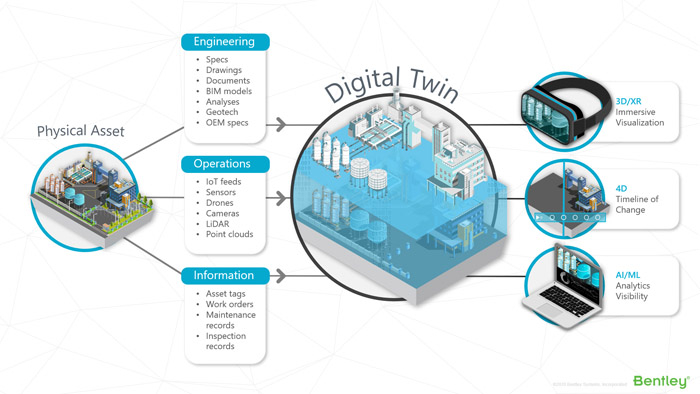
A functional digital twin is built upon three essential, interconnected pillars:
-
The Physical Entity: This is the tangible object, system, or process in the real world. It could be as small as a single component (a bearing in a wind turbine) or as vast as an entire city’s infrastructure.
-
The Virtual Model: This is the digital representation of the physical entity. It exists in a virtual space and is more than just a visual copy; it embodies the physics, mechanics, and operational logic of its twin. This model is built using data from design specifications, engineering principles, and historical performance.
-
The Bi-Directional Data Flow: This is the central nervous system of the digital twin. A network of sensors, IoT devices, and operational software embedded in the physical entity continuously streams data (e.g., temperature, pressure, stress, speed, operational state) to the virtual model. The virtual model processes this data, often using AI and machine learning, to simulate, analyze, and predict behavior. Crucially, the insights generated can then be sent back to the physical entity to optimize its performance, creating a closed-loop, intelligent system.
A.2. The Evolution: From Simulation to Living Replica
It’s critical to distinguish a digital twin from its technological predecessors. Traditional simulation models are static and used primarily for design and testing in a controlled, hypothetical environment. A digital twin, however, is a living simulation that evolves throughout the entire lifecycle of the physical asset. It learns from real-world operations, adapts to changing conditions, and provides insights that are context-aware and continuously relevant. While simulation asks “what if?” under set conditions, a digital twin constantly answers “what is, what was, and what will be?” based on live reality.
B. The Engine Room: How Digital Twins Actually Work in Practice
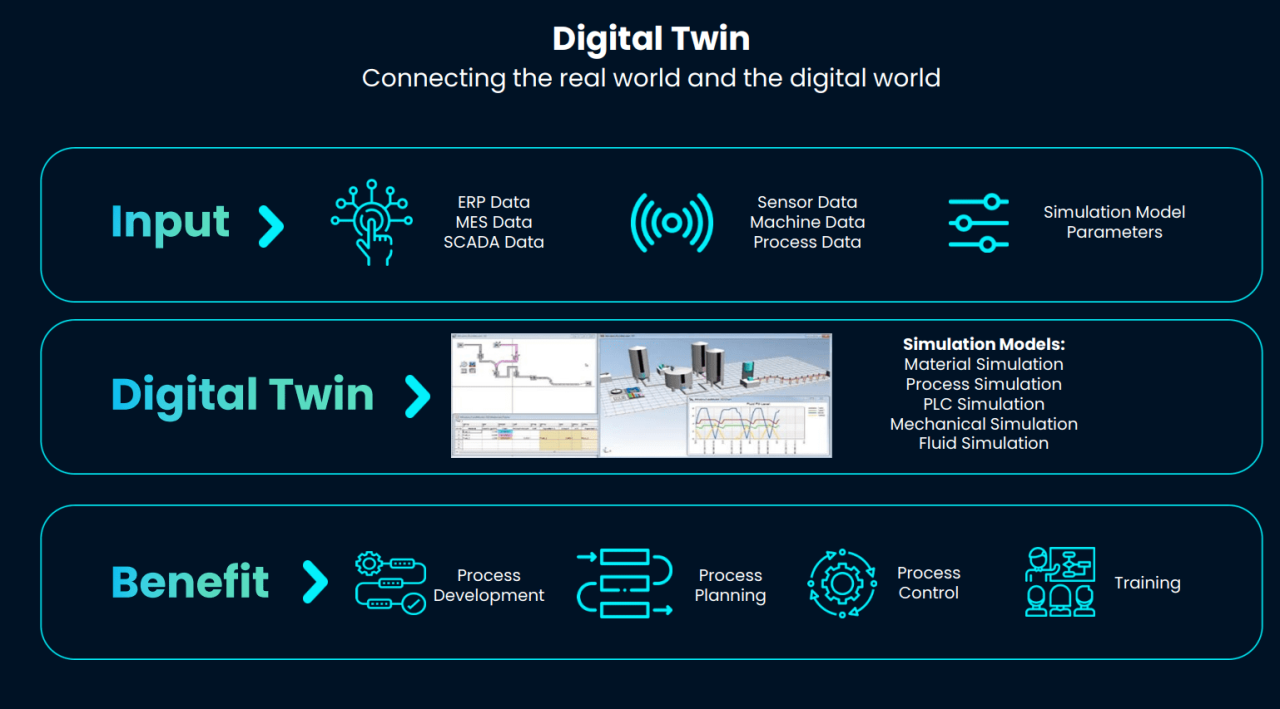
The operational lifecycle of a digital twin can be broken down into a continuous, four-stage cycle:
B. Data Acquisition and Ingestion: The process begins with the physical asset. A multitude of sensors collect real-time data on every conceivable metric. This data is transmitted securely to a cloud or edge computing platform where the virtual model resides.
C. Data Integration and Modeling: The raw data is ingested, cleaned, and harmonized. It is then fused with other data sources, such as historical maintenance records, enterprise resource planning (ERP) data, and even external data like weather patterns. This enriched dataset is used to update the virtual model, ensuring it is a perfect reflection of the current state.
D. Analytics and Simulation: This is where the magic happens. Using advanced analytics, machine learning algorithms, and physics-based simulations, the digital twin processes the integrated data. It can identify anomalies, detect patterns, run “what-if” scenarios, and predict future outcomes with remarkable accuracy. For instance, it can simulate the effect of running a machine at 10% higher capacity for the next 48 hours.
E. Insight Activation and Action: The insights generated are not meant to remain in the digital realm. They are presented to human operators via dashboards, or they can trigger automated actions directly. This could be an alert for impending failure, a recommendation for a specific maintenance action, or an automatic adjustment to operational parameters to optimize for efficiency or quality.
This virtuous cycle creates a system that grows smarter over time, continuously improving the performance and understanding of its physical twin.
C. The Industrial Metamorphosis: Sector-by-Sector Transformation
The application of digital twins is not confined to a single industry. Its versatility is leading to a wave of innovation across the global economy.
C.1. Manufacturing: The Birth of the Smart Factory
Manufacturing is the quintessential use case for digital twins, serving as the backbone of Industry 4.0.
-
Product Design and Development: Engineers can create and test thousands of virtual prototypes using digital twins, drastically reducing the need for costly physical prototypes. They can simulate wear and tear, stress fractures, and aerodynamic performance long before a single piece of metal is cut.
-
Production Line Optimization: A digital twin of an entire production line can simulate workflow, identify bottlenecks, and test new configurations without disrupting actual production. This leads to optimized throughput, reduced energy consumption, and minimized downtime.
-
Predictive and Prescriptive Maintenance: This is a multi-billion dollar application. Instead of following a rigid maintenance schedule or waiting for a machine to break (reactive), digital twins can predict exactly when a component will fail. They can prescribe the specific maintenance needed, allowing repairs to be scheduled during planned downtime, avoiding catastrophic failures and saving immense costs.
C.2. Urban Planning and Smart Cities: Building the Future Virtually
Cities are immensely complex systems, and digital twins are becoming the ultimate urban planning tool.
-
Infrastructure Management: A city can have a digital twin of its entire infrastructure roads, bridges, water pipes, and the electrical grid. The twin can simulate traffic patterns to optimize light timings, monitor structural health of bridges, and predict where water main breaks are likely to occur.
-
Energy Efficiency and Sustainability: Urban digital twins can model energy consumption across the city, identifying areas for improvement. Planners can simulate the impact of new green spaces on urban heat islands or test the efficiency of public transportation routes before implementation.
-
Disaster Response and Public Safety: In the event of a natural disaster or a major incident, emergency services can use the digital twin to simulate evacuation routes, plan resource deployment, and understand the potential impact of their decisions in a risk-free environment.
C.3. Healthcare: Personalizing Medicine and Improving Outcomes
The human body is the ultimate complex system, and digital twins are poised to revolutionize personalized medicine.
-
Personalized Organ and Patient Twins: Researchers are developing digital twins of individual organs, such as the heart. By combining a patient’s medical scans, genetic data, and real-time biometrics from wearables, a cardiologist can simulate how a new medication will affect the patient’s heart or plan a complex surgical procedure in the virtual space first.
-
Hospital Operations Optimization: A digital twin of a hospital can simulate patient flow, staff allocation, and equipment utilization. This can help reduce waiting times, ensure critical equipment is available when needed, and optimize the use of operating rooms, leading to better patient care and lower operational costs.
-
Pharmaceutical Research and Development: In drug discovery, digital twins can simulate how new compounds interact with virtual models of diseases or human physiology, accelerating the R&D process and reducing the reliance on animal and early-stage human trials.
C.4. Aerospace and Automotive: Engineering for Peak Performance and Safety
These high-stakes industries, where failure is not an option, were among the earliest adopters of digital twin technology.
-
Aerospace: From Design to In-Flight Monitoring: Companies like Airbus and Boeing use digital twins for every aircraft they produce. The twin is used from the design phase through to its entire operational life. During a flight, thousands of sensors stream data back to the ground-based digital twin, allowing engineers to monitor the health of the airframe and engines in real-time, predicting maintenance needs and ensuring maximum safety.
-
Automotive: Developing the Connected and Autonomous Vehicle: Automotive manufacturers use digital twins to test autonomous driving algorithms in millions of virtual miles of driving scenarios, something that would be impossibly dangerous, time-consuming, and expensive to do in the real world. They also use them to create connected car services that offer predictive maintenance alerts to drivers.
C.5. Energy and Utilities: Powering a Sustainable Future
The energy sector relies on massive, distributed, and critical infrastructure, making it ideal for digital twin deployment.
-
Wind Farm Optimization: Each wind turbine in a farm can have its own digital twin. The twins can analyze weather data, turbine performance, and grid demand to automatically adjust the pitch of the blades and the yaw of the nacelles to maximize energy output while minimizing mechanical stress.
-
Smart Grid Management: A digital twin of the entire power grid can balance supply and demand in real-time, integrate renewable energy sources like solar and wind more effectively, and simulate the impact of potential failures or cyber-attacks to enhance resilience.
D. The Inevitable Hurdles: Challenges and Considerations
Despite its immense potential, the widespread adoption of digital twins is not without significant challenges.
-
Data Management and Quality: A digital twin is only as good as the data it receives. Managing the sheer volume, velocity, and variety of data (Big Data) from countless sensors requires robust data infrastructure. Inaccurate or incomplete data leads to flawed simulations and unreliable insights a scenario often termed “garbage in, garbage out.”
-
Integration and Interoperability: Most large organizations operate with legacy systems that were not designed to communicate seamlessly. Integrating these siloed systems with a unified digital twin platform can be a monumental technical and organizational challenge.
-
Security and Cybersecurity: A digital twin connected to critical infrastructure becomes a high-value target for cyber-attacks. A malicious actor gaining control could not only steal sensitive operational data but could also send malicious commands back to the physical asset, causing real-world damage. Ensuring end-to-end security is paramount.
-
Cost and Complexity: Developing and maintaining a sophisticated digital twin, especially for large-scale systems, requires a significant investment in technology, specialized talent (data scientists, AI engineers), and organizational change management. For small and medium-sized enterprises, this can be a major barrier to entry.
-
Skills Gap and Cultural Resistance: The successful implementation of digital twins requires a workforce skilled in data analytics, IoT, and AI. Furthermore, it necessitates a cultural shift from traditional, experience-based decision-making to a data-driven, collaborative approach, which can meet with resistance.
E. The Future Horizon: The Next Frontier for Digital Twins
The technology is still evolving, and its future trajectory is even more exciting. We are moving towards an ecosystem of interconnected digital twins.
-
The Rise of Cognitive Digital Twins: The next generation will be infused with more advanced AI, giving them greater cognitive abilities. They will move beyond prediction to autonomous reasoning and decision-making, becoming true collaborative partners for humans.
-
The Enterprise Metaverse: Digital twins will form the foundational layer of the industrial metaverse a persistent, shared virtual space for business. Professionals will be able to don VR headsets and interact with their digital twins in an immersive 3D environment for collaboration, training, and design.
-
Democratization through Platforms: As cloud providers offer more platform-as-a-service (PaaS) solutions for digital twins, the technology will become more accessible and affordable, enabling smaller companies to leverage its power.
-
Sustainability and Climate Resilience: Digital twins will be crucial in the fight against climate change, used to model the impact of climate policies, optimize resource use across supply chains, and design inherently sustainable and resilient cities and infrastructure.
Conclusion: Embracing the Mirror World for a Smarter Tomorrow
The digital twin is far more than a technological novelty; it is a paradigm shift in our relationship with the physical world. It offers a crystal ball for predicting failures, a sandbox for limitless innovation, and a control panel for unprecedented optimization. While challenges in data, security, and integration remain, the benefits ranging from colossal cost savings and enhanced safety to accelerated innovation and a more sustainable planet are simply too profound to ignore.
As sensors become cheaper, connectivity becomes ubiquitous, and AI becomes more powerful, the adoption of digital twins will become as standard as having a website is today. Industries, cities, and even individuals who learn to harness the power of their virtual counterparts will unlock new levels of efficiency, resilience, and intelligence, leading the charge into a future where the digital and physical worlds are seamlessly intertwined for the betterment of all. The revolution is not coming; it is already here, being built one digital twin at a time.